Association between Internet use patterns and Internet addiction among Peruvian adolescents
DOI:
https://doi.org/10.37711/rpcs.2025.7.4.9Keywords:
Internet, dependency, psychological, adolescent behavior, semantics, addictionAbstract
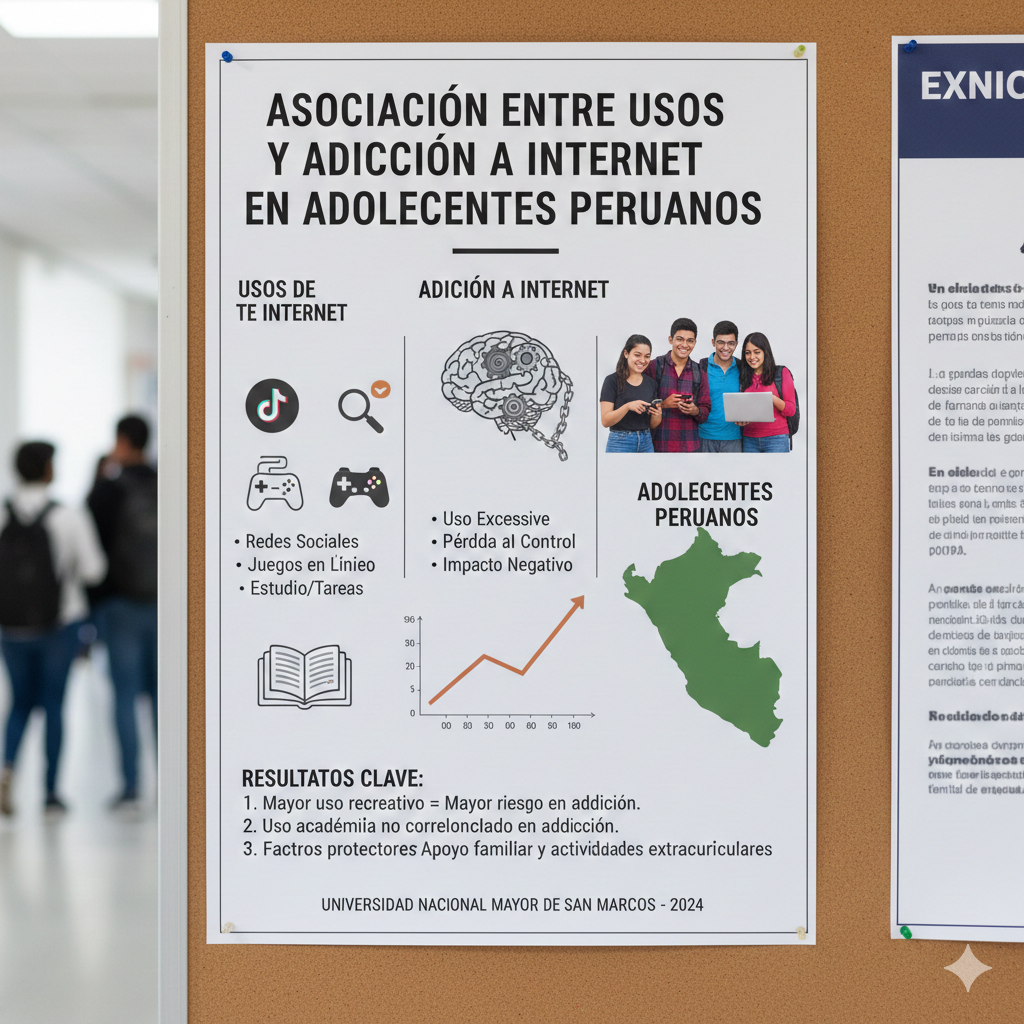
Objective. To determine the association between types of Internet use and Internet addiction among adolescents, specifically analyzing its dimensions: excessive use, tolerance, withdrawal, and negative consequences. Methods. A cross-sectional mixed-methods study was conducted with 487 Peruvian secondary school students (aged 13–18 years), in which semantic content analysis predominated. Young’s Internet Addiction Test (adapted version) was applied, along with the natural semantic networks technique (co-occurrence networks using KH Coder) to categorize types of Internet use. Results. High levels of addiction were not limited to leisure activities but also included academic uses, such as studying, virtual classes, and completing homework. High tolerance was associated with a wide range of academic, social, and recreational activities. High excessive use showed a simultaneous integration of academic, leisure, and social activities, reflecting hyperconnectivity. High withdrawal was mainly related to the interruption of social and entertainment activities, whereas high punishment levels were associated with negative consequences in academic, family, and psychological domains. Conclusions. An association was found between types of Internet use and the severity of Internet addiction among adolescents, with the intensity and compulsive nature of online activities being more determinant than total connection time. Tolerance, excessive use, withdrawal symptoms, and neglect of daily responsibilities are expressed through the progressive normalization of habits encompassing academic, leisure, and social activities, as well as through emotional dysregulation when connectivity is interrupted.
Downloads
References
1. Gutiérrez Beltrán A, Buiza Chuquitaype LG. Adicción al Internet y las redes sociales en estudiantes de primaria, secundaria y superior. Horizontes [Internet]. 2024 [Consultado el 9 de marzo de 2025];8(32):449-63. https://doi.org/10.33996/revistahorizontes.v8i32.736
2. Young KS. Internet addiction: The emergence of a new clinical disorder. Cyberpsychol Behav. [Internet]. 1998 [Consultado el 9 de marzo de 2025]; 1(3):237-44. https://doi.org/10.1089/cpb.1998.1.237
3. Livingstone S, Mascheroni G, Stoilova M. The outcomes of gaining digital skills for young people’s lives and wellbeing: a systematic evidence review. New Media Soc. [Internet]. 2021 [Consultado el 25 de diciembre de 2025];25(5):1176-1202. https://doi.org/10.1177/14614448211043189
4. Li, X., He, X., Liang, W., Fan, W. The impact of Internet use on adolescent learning outcomes: Evidence from rural China. China Agricultural Economic Review [Internet]. 2021 [Consultado el 25 de diciembre de 2025];13(1):32-50. https://doi.org/ 10.1108/CAER-07-2020-0172
5. Morita, H., Griffioen, N., Granic, I. Digital Media and the Dual Aspect of Adolescent Identity Development The Effects of Digital Media Use on Adolescents’ Commitments and Self-Stories [Internet]. En: Nesi J, Telzer EH, Prinstein M, editores. Handbook of Adolescent Digital Media Use and Mental Health. 2nd ed. Cambridge: Cambridge University Press; 2023. p. 63-84. [Consultado el 25 de diciembre de 2025 https://doi.org/10.1017/9781108976237
6. Ehrenreich, SE. Peer Relationship Processes in the Context of Digital Media [Internet]. En: Nesi J, Telzer EH, Prinstein M, editors. Handbook of Adolescent Digital Media Use and Mental Health. 2nd ed. Cambridge: Cambridge University Press; 2023. p. 85-103. [Consultado el 25 de diciembre de 2025]. https://doi.org/10.1017/9781108976237
7. Griffiths M. A 'components' model of addiction within a biopsychosocial framework. Journal of Subst Use [Internet]. 2005 [Consultado el 09 de marzo de 2025];10(4):191-197. https://doi.org/10.1080/14659890500114359
8. Toro-Huamanchumo CJ, Barboza BK, León-Figueroa DA, Rodríguez-Miñano E, Barboza JJ. Eficacia de los programas de tratamiento para ciberadicción en niños y adolescentes: revisión sistemática y meta-análisis. Rev. Cuerpo Med. Hosp. Nac. Almanzor Aguinaga Asenjo [Internet]. 2022 [Consultado el 07 de junio de 2025];15(Supl. 1):e1490. https://doi.org/10.35434/rcmhnaaa.2022.15Supl.201.1490
9. Davis RA. A cognitive-behavioral model of pathological Internet use. Computers in Human Behavior. [Internet]. 2001 [Consultado el 09 de marzo de 2025];17(2):187-195. https://doi.org/10.1016/S0747-5632(00)00041-8
10. Chamberlain SR, Lochner C, Stein DJ, Goudriaan AE, Van Holst RJ, Zohar J, et al. Behavioural addiction – A rising tide? European Neuropsychopharmacol. [Internet]. 2016 [Consultado el 26 de marzo de 2025];26(5):841-855. https://doi.org/10.1016/j.euroneuro.2015.08.013
11. Lin CH, Wang CC, Sun JH, Ko CH, Chiou YC. Internet addiction: A general term for compulsions in digital use. Frontiers in Psychiatry [Internet]. 2019 [Consultado el 26 de marzo de 2025];10:232. https://doi.org/10.3389/fpsyt.2019.00232
12. Billieux J, Schimmenti A, Khazaal Y, Maurage P, Heeren A. Are we overpathologizing everyday life? J Behav Addict. [Internet]. 2015 [Consultado el 25 de diciembre de 2025];4(3):119-23. https://doi:10.1556/2006.4.2015.009
13. Zuboff S. The age of surveillance capitalism: The fight for a human future at the new frontier of power. New York: PublicAffairs; 2019.
14. Orben A. The Sisyphean cycle of technology panics. Perspect Psychol Sci [Internet]. 2020 [Consultado el 25 de diciembre de 2025];15(5):1143-57. https://doi:10.1177/1745691620919372
15. Granic I, Morita H, Scholten H. Beyond screen time: Identity development in the digital age. Psychol Inq. [Internet]. 2020 [Consultado el 25 de diciembre de 2025];31(3):195-223. https://doi:10.1080/1047840X.2020.1820214
16. Ellis DA, Davidson BI, Shaw H, Geyer K. Do smartphone usage scales predict behavior? Int J Hum Comput Stud. [Internet]. 2019 [Consultado el 25 de diciembre de 2025];130:86-92. https://doi:10.1016/j.ijhcs.2019.05.004
17. Kardefelt-Winther D. A conceptual and methodological critique of Internet addiction research: Towards a model of compensatory Internet use. Comput Human Behav. [Internet]. 2014 [Consultado el 25 de diciembre de 2025];31:351-354. https://doi:10.1016/j.chb.2013.10.059
18. Snodgrass JG, Lacy MG, Dengah HJF 2nd, Eisenhauer S, Batchelder G, Cookson RJ. A vacation from your mind: Problematic online gaming is a stress response. Comput Human Behav. [Internet]. 2014 [Consultado el 25 de diciembre de 2025];38:248-260. https://doi:10.1016/j.chb.2014.06.004
19. Meier A, Reinecke L. Computer-mediated communication, social media, and mental health: A conceptual and empirical meta-review. Commun Res. [Internet]. 2021 [Consultado el 25 de diciembre de 2025];48(8):1182-1209. https://doi:10.1177/0093650220958224
20. Johannes N, Meier A, Reinecke L, Ehlert S, Setiawan DN, Walasek N, et al. The relationship between online vigilance and affective well-being in everyday life: Combining smartphone logging with experience sampling. Media Psychol. [Internet]. 2023 [Consultado el 25 de diciembre de 2025];26(3):255-277. https://doi.org/10.1080/15213269.2020.1768122
21. Instituto Nacional de Estadística e Informática. Encuesta Nacional de Hogares sobre acceso a Internet [Internet]. Lima: INEI; 2022 [Consultado el 18 de setiembre de 2025]. Disponible en: https://www.inei.gob.pe/media/MenuRecursivo/publicaciones_digitales/Est/Lib1905/
22. Basauri DM. Adicción al Internet y pensamientos automáticos en estudiantes de secundaria de una institución pública de Villa El Salvador. Acta Psicológica Peruana [Internet]. 2021 [Consultado el 26 de marzo de 2025];6(2):171-191. https://doi.org/10.56891/acpp.v6i2.356
23. Colonio Caro JD. Revisión sistemática sobre la adicción a las redes sociales en adolescentes latinoamericanos entre el 2020-2022. Propósitos y Representaciones [Internet]. 2023 [Consultado el 14 de abril de 2025];11(2):e1759. https://doi.org/10.20511/pyr2023.v11n2.1759
24. Vilca HM, Sosa F, Mamani YM. Redes sociales y su relación con el nivel de rendimiento académico en estudiantes universitarios de educación de la región andina de Perú. Encuentros. Revista de Ciencias Humanas, Teoría Social y Pensamiento Crítico, (Extra) [Internet]. 2022 [Consultado el 14 de abril de 2025];137-154. https://doi.org/10.5281/zenodo.6551075
25. Estrada JA, Gallegos MR, Córdova SE. Habilidades sociales y adicción al Internet en estudiantes de secundaria de Lima. Rev Archivos Venezolanos de Farmacología y Terpéutica [Internet]. 2021 [Consultado el 14 de abril de 2025];40:101-117. https://doi.org/10.5281/zenodo.4675699
26. Malinauskas R, Malinauskiene V. A meta-analysis of psychological interventions for Internet/smartphone addiction among adolescents. Journal of Behavioral Addictions [Internet]. 2019 [Consultado el 14 de abril de 2025];8(4):613-624. https://doi.org/10.1556/2006.8.2019.72
27. Mo PKH, Chan VWY, Chan SW, Lau JTF. The role of social support on emotion dysregulation and Internet addiction among Chinese adolescents: A structural equation model. Addictive Behaviors [Internet]. 2018 [Consultado el 1 de mayo de 2025];82:86-93. https://doi.org/10.1016/j.addbeh.2018.01.027
28. Lam LT. Risk factors of Internet addiction and the health effect of Internet addiction on adolescents: a systematic review of longitudinal and prospective studies. Curr Psychiatry Rep. [Internet]. 2014 [Consultado el 1 de mayo de 2025];16:508. https://doi.org/10.1007/s11920-014-0508-2
29. Ko CH, Yen JY, Liu SC, Huang CF, Yen CF. The associations between aggressive behaviors and Internet addiction and online activities in adolescents. Journal of Adolescent Health [Internet]. 2009 [Consultado el 1 de mayo de 2025];44:598-605. https://doi.org/10.1016/j.jadohealth.2008.11.011
30. Winkler A, Dörsing B, Rief W, Shen Y, Glombiewski JA. Treatment of Internet addiction: a meta-analysis. Clin Psychol Rev [Internet]. 2013 [Consultado el 1 de mayo de 2025];33:317-329. https://doi.org/10.1016/j.cpr.2012.12.005
31. Tang J, Yu Y, Du Y, Ma Y, Zhang D, Wang J. Prevalence of Internet addiction and its association with stressful life events and psychological symptoms among adolescent Internet users. Addict Behav. [Internet]. 2014 Mar [Consultado el 1 de mayo de 2025];39(3):744-7. doi: 10.1016/j.addbeh.2013.12.010
32. Andreassen CS. Online social network addiction: A comprehensive review. Curr Addict Rep 2 [Internet]. 2015 [Consultado el 26 de marzo de 2025];2(2):175-184. https://doi.org/10.1007/s40429-015-0056-9
33. Brand M, Young KS, Laier C, Wölfling K, Potenza MN. Integrating psychological and neurobiological considerations regarding the development and maintenance of specific Internet-use disorders: An Interaction of Person-Affect-Cognition-Execution (I-PACE) model. Neurosci Biobehav Rev. [Internet]. 2016 [Consultado el 10 de agosto de 2025];71:252-266. https://doi.org/10.1016/j.neubiorev.2016.08.033
34. Ministerio de Educación del Perú. Censo Escolar 2023 - Resultados Nacionales y Regionales [Internet]. Lima: MINEDU; 2023 [Consultado el 18 de setiembre de 2025]. Disponible en: https://escale.minedu.gob.pe/estadistica-de-la-calidad-educativa
35. Matalinares M, Raymundo O, Baca D. Adaptación del Test de Adicción al Internet [Internet]. Lima: Universidad Nacional Mayor de San Marcos; 2012 [Consultado el 28 de setiembre de 2025]. Disponible en: https://repositorio.continental.edu.pe/handle/20.500.12394/11088
36. Figueroa J.G., Gonzalez E.G, Solis V.M. An approach to the problem of meaning: Semantic networks. Journal of Psycholinguist Research [Internet]. 1976 [Consultado el 18 de setiembre de 2025];5(2):107-15. https://doi.org/10.1007/BF01067252
37. Higuchi K. KH Coder 3: A free software for quantitative content analysis or text mining. Kioto: Ritsumeikan University [Internet]. 2016 [Consultado el 28 de setiembre de 2025]. Disponible en: https://khcoder.net/en/
38. Sober E. Ockham’s razor [Internet]. Cambridge: Cambridge University Press; 2015 [Consultado el 24 de diciembre de 2025]. https://doi.org/10.1017/CBO9781107705937
39. Universidad Nacional Mayor de San Marcos. Código de ética en investigación de la UNMSM. Resolución rectoral N.º 012648-2023-R/UNMSM (2023 Nov 21).
40. Basteiro J, Robles-Fernández A, Juarros-Basterretxea, Pedrosa I. Adicción a las Redes Sociales: Creación y Validación de un instrumento de medida. Revista de Investigación y Divulgación en Psicología y Logopedia [Internet]. 2013 [Consultado el 10 de agosto de 2025];3(1):2-8. Disponible en: https://www.researchgate.net/publication/258934148_Adiccion_a_las_redes_sociales_creacion_y_validacion_de_un_instrumento_de_medida_Social_networks_addiction_development_and_validation_ofanassessment_instrument
41. Kuss DJ, Griffiths MD, Karila L, Billieux J. Internet addiction: a systematic review of epidemiological research for the last decade. Current Pharmaceutical Design. [Internet]. 2014 [Consultado el 10 de agosto de 2025];20(25):4026-4052. https://doi:10.2174/13816128113199990617
42. Şenormancı Ö, Saraçlı Ö, Atasoy N, Şenormancı G, Koktürk F, Atik L. Relationship of Internet addiction with cognitive style, personality, and depression in university students. Compr Psychiatry [Internet]. 2014 [Consultado el 18 de setiembre de 2025];55(6):1385-190. https://doi:10.1016/j.comppsych.2014.04.025
43. Xiuqin H, Huimin Z, Mengchen L, Jinan W, Ying Z, Ran T. Mental health, personality, and parental rearing styles of adolescents with Internet addiction disorder. Cyberpsycholog, Behavior and Social Networking [Internet]. 2010 [Consultado el 28 de setiembre de 2025];13(4):401-406. https://doi:10.1089/cyber.2009.0222
44. Sharma MK, Palanichamy TS. Psychosocial interventions for technological addictions. Indian Journal Psychiatry [Internet]. 2018 [Consultado el 28 de setiembre de 2025];60(Suppl 4):S541-S545. https://doi:10.4103/psychiatry.indianjpsychiatry_40_18
Downloads
Published
Issue
Section
License
Copyright (c) 2026 Lucero Rubí Baltazar Jara , Alberto Loharte Quintana Peña

This work is licensed under a Creative Commons Attribution 4.0 International License.