Aprendizaje autorregulado en estudiantes universitarios: revisión sistemática de evidencia empírica (2015-2025)
DOI:
https://doi.org/10.37711/desafios.2025.16.2.9Palabras clave:
aprendizaje autorregulado, educación superior, autoeficacia académica, estrategias de aprendizaje, revisión sistemáticaResumen
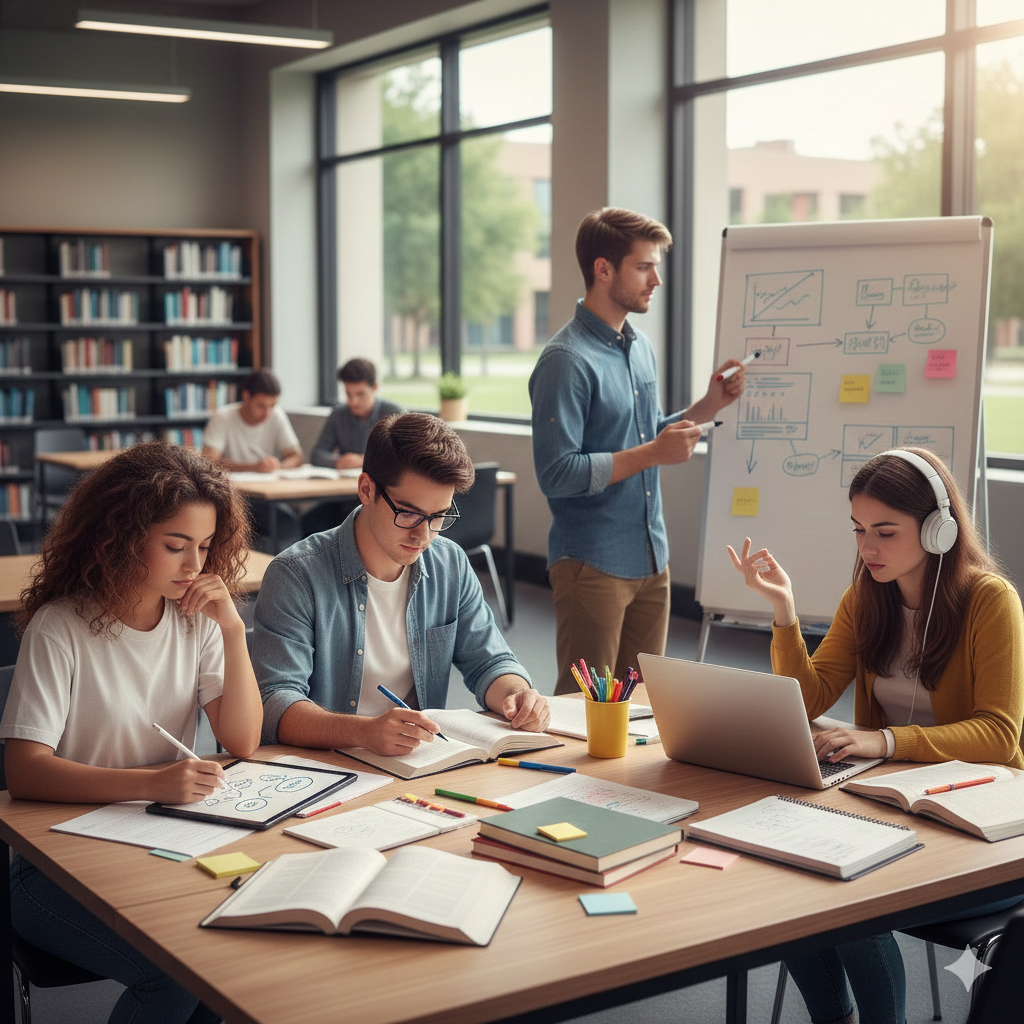
Este estudio tuvo como objetivo revisar sistemáticamente investigaciones empíricas (2015-2025) sobre el aprendizaje autorregulado en universitarios. Se aplicó una metodología de revisión sistemática bajo los lineamientos PRISMA, con un diseño documental y descriptivo. Para ello, se analizaron 34 estudios revisados por pares, publicados en revistas científicas indexadas en Scopus, Web of Science, SciELO, Redalyc, ERIC y Google Académico. Los resultados muestran niveles medios de autorregulación, con diferencias según género, estrés y rendimiento académico; se destaca, además, que las intervenciones más efectivas fueron talleres, tutorías, mentorías y tecnologías. Así mismo, se identificó una relación positiva con la autoeficacia y la resiliencia. En conclusión, la autorregulación se consolida como un factor clave para el éxito académico y debe promoverse desde el currículo, la formación docente y el uso de recursos tecnológicos.
Descargas
Referencias
Anthonysamy, L., Choo Ah, K., & Hew, S. (2021). Investigating Self-Regulated Learning Strategies for Digital Learning Relevancy. Malaysian Journal of Learning and Instruction, 1(1), 29-64. https://doi.org/https://doi.org/10.32890/mjli2021.18.1.2
Arratia, G. (2024). Autorregulación del Aprendizaje y Éxito Académico en Estudiantes de Enfermería en una Universidad del Sur del Perú. Revista Veritas Et Scientia – Perú, 13(2), 341-348. https://doi.org/10.47796/ves.v13i2.1154
Artuch, R., González, M., De la Fuente, J., Mariano, M., Fernández, M., & López, M. (2017). Relationship between resilience and self-regulation: A study of Spanish youth at risk of social exclusion. Frontiers in Psychology, 20(8). https://doi.org/10.3389/fpsyg.2017.00612
Blanco, E., Galve-González, C., Herrero, F., y Bernardo, A. B. (2022). Intención de abandono y resiliencia en estudiantes universitarios de nuevo ingreso. Magister, 34, 17-23. https://doi.org/10.17811/msg.34.1.2022.17-23
Broadbent, J., & Poon, W. (2015). Self-regulated learning strategies & academic achievement in online higher education learning environments: A systematic review. Internet and Higher Education, 27, 1-13. https://doi.org/10.1016/j.iheduc.2015.04.007
Burbano-Larrea, P., Basantes-Vásquez, M., y Ruiz-Lapuerta, I. (2021). Autorregulación del aprendizaje en estudiantes universitarios: un estudio descriptivo. Cátedra, 4(3), 74-92. https://doi.org/10.29166/catedra.v4i3.3048
Cerezo, R., Fernández, E., Amieiro, N., Valle, A., Rosário, P., & Núñez, C. (2019). Mediating Role of Self-efcacy and Usefulness Between Self-regulated Learning Strategy Knowledge and its Use El papel mediador de la autoefcacia y la utilidad entre el conocimiento y el uso de estrategias de autorregulación del aprendizaje. Revista de Psicodidáctica, 24(1), 1-8. https://doi.org/10.1016/j.psicod.2018.08.001
Demuner, M. (2023). Estrategias de aprendizaje autorregulado y el rendimiento no académico en el contexto de la pandemia COVID-19. Publicaciones, 53(3), 179-213. https://doi.org/10.30827/publicaciones.v53i3.23773
Dent, A., & Koenka, A. (2016). The Relation Between Self-Regulated Learning and Academic Achievement Across Childhood and Adolescence: A Meta-Analysis. Educational Psychology Review, 28(3), 425-474. https://doi.org/10.1007/s10648-015-9320-8
Díaz Mujica, A., Pérez Villalobos, M., González-Pienda, J., y Nuñez Pérez, J. (2017). Impacto de un entrenamiento
en aprendizaje autorregulado en estudiantes universitarios. Perfles Educativos, 39(157), 87-104. https://www.scielo.org.mx/scielo.php?script=sci_arttext&pid=S0185-26982017000300087
Fan, J., Fan, Y., & Wang, H. (2023). The impact of overqualifcation on the intention of urban withdrawal from the perspective of talent crowding. Heliyon, 9(5). https://doi.org/10.1016/j.eliyon.2023.e16174
Faza, A., & Lestari, I. A. (2025). Self-Regulated Learning in the Digital Age: A Systematic Review of Strategies, Technologies, Benefts, and Challenges. International Review of Research in Open and Distributed Learning, 26(2), 23-58. https://doi.org/10.19173/irrodl.v26i2.8119
Gaxiola Romer, J. C., y González Lugo, S. (2019). Apoyo percibido, resiliencia, metas y aprendizaje autorregulado en
bachilleres. Revista Electrónica de Investigación Educativa, 21, 1-10. https://doi.org/10.24320/redie.2019.21.e08.1983
Latipah, E., Kistoro, H. C. A., & Putranta, H. (2021). How are theparents involvement, peers and agreeableness personality of lecturers related to self-regulated learning? European Journal of Educational Research, 10(1), 413-425. https://doi.org/10.12973/EU-JER.10.1.413
Medrano Gallegos, V., Ordaz Guzmán, T., y Villaseñor Zuñiga, M. L. (2025). Revisión de literatura sobre la autorregulación del aprendizaje en estudiantes universitarios de modalidad virtual. Ediciones Comunicación Científca, 33-50. https://doi.org/10.52501/cc.282.01
Nuñez, M. E., García, P. M, & Abbas, A. (2023). The mediating role of self-regulation between emotional intelligence and student performance in online global classroom-based collaborative international online learning (COIL):
Empirical evidence from four partner universities of Latin America. Research in Globalization, 7.
https://doi.org/10.1016/j.resglo.2023.100178
Omar, S., Hussein, N., Hanapi, N., Abdullah, Y., Mohd, A., & Saidi, S. (2023). Self-Efcacy and Self-Regulated Learning Among Undergraduate in Learning Arabic as a Foreign Language Via Online. Issues in Language Studies, 12(2), 227-245. https://doi.org/10.33736/ils.5566.2023
Osakwe, I., Chen, G., Fan, Y., Rakovic, M., Li, X., Singh, S., Molenaar, I., Bannert, M., & Gasevic, D. (2023). Reinforcement learning for automatic detection of effective strategies for self-regulated learning. Computers and Education: Artifcial Intelligence, 5. https://doi.org/10.1016/j.caeai.2023.100181
Panadero, E. (2017). A review of self-regulated learning: Six models and four directions for research. Frontiers in Psychology, 8, 422. https://doi.org/10.3389/fpsyg.2017.00422
Ruiz Alzate, L., y Roncancio Moreno, M. (2023). Promoción del aprendizaje autorregulado mediado por la virtualidad en la educación superior. Revista Guillermo de Ockham, 21(2), 447-461. https://doi.org/10.21500/22563202.5856
Sáez Delgado, F., García Vásquez, H., Mella Norambuena, J., López Angulo, Y., Olea González, C., y Contreras Saavedra, C. (2023). Rendimiento académico y autorregulación del aprendizaje en estudiantado Secundario Técnico
Profesional chileno durante el COVID-19. Revista Educación, 47(2), 106-132. https://doi.org/10.15517/revedu.
v47i2.53640
Sáez-Delgado, F., López-Angulo, Y., Arias-Roa, N., y MellaNorambuena, J. (2022). Revisión sistemática sobre autorregulación del aprendizaje en estudiantes de secundaria. Perspectiva Educacional, 61(2). https://doi.org/10.4151/07189729-vol.61-iss.2-art.1247
Simón-Grábalos, D., Fonseca, D., Aláez, M., Romero-Yesa, S., & Fresneda-Portillo, C. (2025). Systematic Review
of the Literature on Interventions to Improve SelfRegulation of Learning in First-Year University Students.
Education Sciences, 15(3), 372. https://doi.org/10.3390/educsci15030372
Tekkol, I. A., & Demirel, M. (2018). An investigation of self-directed learning skills of undergraduate students. Frontiers in Psychology, 9, 2324. https://doi.org/10.3389/fpsyg.2018.02324
Terry Advíncula, S., y Tucto Aguirre, S. (2021). Hábitos de estudio y aprendizaje autorregulado en estudiantes universitarios. Revista EDUCA UMCH, 17, 121-133. https://doi.org/10.35756/educaumch.202117.167
Tise, J., Hernandez, P., & Wesley, P. (2023). Mentoring underrepresented students for success: Self-regulated
learning strategies as a critical link between mentor support and educational attainment. Contemporary Educational Psychology, 75(1),102233. https://doi.org/10.1016/j.cedpsych.2023.102233
Tomas, N., & Poroto, A. (2023). The interplay between self-regulation, learning flow, academic stress and learning engagement as predictors for academic performance in a blended learning environment: A cross-sectional survey. Heliyon, 9(11). https://doi.org/10.1016/j.heliyon.2023.e21321
Turan, Z., Kucuk, S., & Cilligol, S. (2022). The university students’ self-regulated effort, flexibility and satisfaction in
distance education. International Journal of Educational Technology in Higher Education, 19(1). https://doi.org/10.1186/s41239-022-00342-w
Tzimas, D. E., & Demetriadis, S. N. (2024). Impact of Learning Analytics Guidance on Student Self-Regulated Learning Skills, Performance, and Satisfaction: A Mixed Methods Study. Education Sciences, 14(1), 92. https://doi.org/10.3390/educsci14010092
Van Alten, D., Phielix, C., Janssen, J., & Kester, L. (2020). Self-regulated learning support in flipped learning videos enhances learning outcomes. Computers and Education, 158, 104000. https://doi.org/10.1016/j.compedu.2020.104000
Vizcaino-Escobar, A., Céspedes-Rodríguez, H., Matos-Matos, A., SáezDelgado, F., Olena-Klimenko., J. A. (2024). Aprendizaje autorregulado, rendimiento y estrés académico en estudiantes universitarios. Revista Médica Electrónica, 46. https://search.bvsalud.org/portal/resource/pt/biblio-1584093
Wang, H., Yang, J., & Li, P. (2022). How and when goal-oriented self-regulation improves college students’ well-being: Aweekly diary study. Current Psychology, 41(11), 7532-7543.
https://doi.org/10.1007/s12144-020-01288-w
Xu, Z., Zhao, Y., Zhang, B., Liew, J., & Kogut, A. (2023). A meta-analysis of the efcacy of self-regulated learning interventions on academic achievement in online and blended environments in K-12 and higher education. Behaviour and Information Technology, 42(16), 2911-2931. https:// doi.org/10.1080/0144929X.2022.2151935
Descargas
Publicado
Número
Sección
Licencia
Derechos de autor 2025 Edson Fernando Zenteno Alberto, Andrea Velasquez Mendoza

Esta obra está bajo una licencia internacional Creative Commons Atribución 4.0.
a. Los autores conservan los derechos de propiedad intelectual (copyright) de las obras publicadas, cediendole a la revista el derecho de primera publicación.
b. Los autores retienen sus derechos de marca y patente, y también sobre cualquier proceso o procedimiento descrito en el artículo.
c. Los autores retienen el derecho de compartir, copiar, distribuir, ejecutar y comunicar públicamente el artículo publicado en la RD (por ejemplo, colocarlo en un repositorio institucional o publicarlo en un libro), con un reconocimiento de su publicación inicial en la RD.
d. Los autores retienen el derecho a hacer una posterior publicación de su trabajo, de utilizar el artículo o cualquier parte de aquel (por ejemplo: una compilación de sus trabajos, notas para conferencias, tesis, o para un libro), siempre que indiquen la fuente de publicación (autores del trabajo, revista, volumen, número y fecha).