Design of a health monitoring system for astronauts based on artificial intelligence
DOI:
https://doi.org/10.37711/repiama.2024.1.2.4Keywords:
monitoreo de salud, inteligencia artificial, astronauta, bioseñales, redes neuronales, sensores biomédicos, salud espacialAbstract
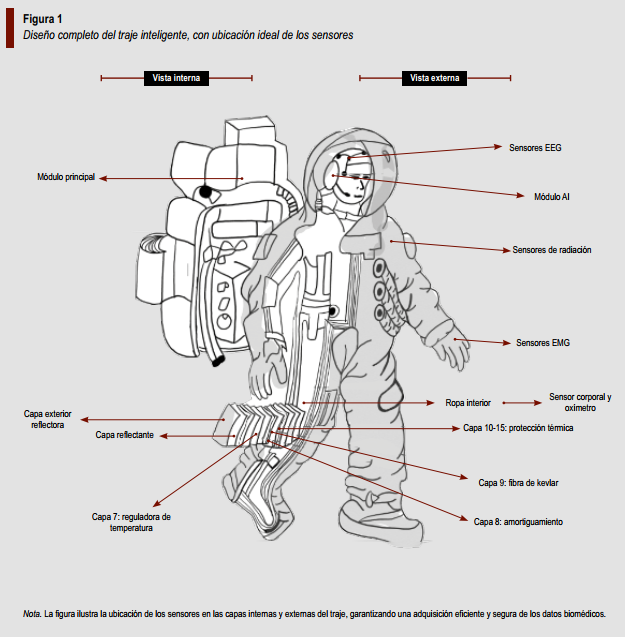
Objective. To design a health monitoring system for astronauts through the integration of the artificial intelligence (AI) and biomedical sensors. Methods. A experimental type study was developed. The population consisted of simulated data of astronauts and the sample was obtained through the intentioned selection of critical biometric parameters. The data was collected using a set of sensors EEG, EMG, and optics, integrated in a smart suit. The signals were processed in real time through a central module with technology ESP32 and the use of neural networks RNN-CNN for the analysis were proposed. Results. An AI architecture is proposed that, theoretically, it could achieve 90% accuracy in detecting potential diseases. The system presented a data transmission rate of 1.5 kbps and a latency of < 100 ms, which would allow real-time monitoring. Conclusions. The system developed has the potential to be effective for the early detection of alterations in the health of astronauts, showing its capacity for safeguarding the safety of space missions
Downloads
References
Boulemtafes, A., Khemissa, H., Derki, M. S., Amira, A., & Djed-jig, N. (2021). Deep learning in pervasive health monitoring, design goals, applications, and architectures: An overview and a brief synthesis. Smart Health, 22, 100221. https://doi.org/10.1016/j.smhl.2021.100221
Corpas Novo, J. A. (2019). Aceleración y optimizacion del con-sumo energetico de clasificadores en cascada para la de-teccion de rostros sobre arquitecturas asimétricas [Tesis doctoral, Universidad de Granada]. Repositorio UG. https://digibug.ugr.es/bitstream/handle/10481/56822/81404.pdf?sequence=4&isAllowed=y
Di Rienzo, M., & Piccirillo, S. G. M. (2021). Wearables for life in space. Wearable Sensors. 463-486. https://doi.org/10.1016/B978-0-12-818475-6.00001-8
Lipková, J., Chen, R. J., Chen, B., Lu, M., Barbieri, M., Shao, D., Vaidya, A., Chen, C., Zhuang, L., Williamson, D. F. K., Shaban, M., Chen, T., & Mahmood, F. (2022). Artificial intelligence for multimodal data integration in oncology. Cancer Cell, 40(10), 1095-1110. https://doi.org/10.1016/j.ccell.2022.09.012
Martin, A. S., & Freeland, S. (2021). The advent of artificial intelligence in space activities: New legal challenges.
Space Policy, 55, 101408. https://doi.org/10.1016/j.space-pol.2021.101408
Roda, A., Mirasoli, M., Guardigli, M., Zangheri, M., Caliceti, C., Calabria, D., & Simoni, P. (2018). Advanced biosensors for monitoring astronauts’ health during long-duration space missions. Biosensors and Bioelectronics, 111, 18-26. https://doi.org/10.1016/j.bios.2018.04.012
Roslee, M. F. (2021). Review of medical capabilities require-ments for manned missions on lunar and Martian surfaces base activities. REACH, 23-24. https://doi.org/10.1016/j.reach.2020.100042
Salvi, M., Loh, H. W., Seoni, S., Barua, P. D., Del Barrio-García, S., Molinari, F., & Acharya, U. R. (2023). Multimodality approaches for medical support systems: A systematic review of the last decade. Information Fusion, 102134. https://doi.org/10.1016/j.inffus.2023.102134
Shaik, T., Tao, X., Li, L., Xie, H., & Velásquez, J. D. (2024). A survey of multimodal information fusion for smart health-care: Mapping the journey from data to wisdom. Information Fusion, 102, 102040. https://doi.org/10.1016/j.inffus.2023.102040
Solís García, E. (2017). Utilización del programa Face2Gene en diferentes escenarios clínicos [Tesis de grado, Univer-sidad de Cantabria]. Repositorio institucional de la Universidad de Cantabria. https://repositorio.unican.es/xmlui/handle/10902/11747
Sujith, A. V. L. N., Sajja, G. S., Mahalakshmi, V., Nuhmani, S., & Balaji, P. (2022). Systematic review of smart health moni-toring using deep learning and artificial intelligence. Neuro-science Informatics, 2(3), 100028. https://doi.org/10.1016/j.neuri.2022.100028
Tipaldi, M., Feruglio, L., Denis, P., & D’Angelo, G. (2020). On applying AI-driven flight data analysis for operational spacecraft model-based diagnostics. Annual Reviews in Control, 49, 197-211. https://doi.org/10.1016/j.arcon-trol.2020.01.001
Vandendriessche, B., Godfrey, A., & Izmailova, E. S. (2021). Multimodal biometric monitoring technologies drive the development of clinical assessments in the home environ-ment. Maturitas,151, 41–47. https://doi.org/10.1016/j.ma-turitas.2021.06.009
Villanueva Alarcón, R. A. (2021). Sistema inteligente basado en redes neuronales para la identificación de cáncer de piel de tipo melanoma en imágenes de lesiones cutáneas [Tesis de grado, Universidad Nacional Mayor de San Marcos]. Cybertesis Repositorio UNMSM. https://hdl.handle.net/20.500.12672/17574
Zangheri, M., Mirasoli, M., Guardigli, M., Di Nardo, F., Anfossi, L., Baggiani, C., Simoni, P., Benassai, M., & Roda, A. (2019). Chemiluminescence-based biosensor for moni-toring astronauts’ health status during space missions: Results from the International Space Station. Biosensors and Bioelectronics, 129, 260-268 https://doi.org/10.1016/j.bios.2018.08.034
Downloads
Published
Issue
Section
License
Copyright (c) 2024 Nataly Andrea Rojas Barnett, Hanks Jeremy Reyes Huaman, Rivaldo Carlos Duran Aquino

This work is licensed under a Creative Commons Attribution 4.0 International License.