Spatial Assessment of Glacier Retreat of Nevado Pastoruri and Its Impact on Tourism Dynamics (1987–2025)
DOI:
https://doi.org/10.37711/repiama.2025.2.2.6Keywords:
climate change, tourism, remote sensing, glacier, degradationAbstract
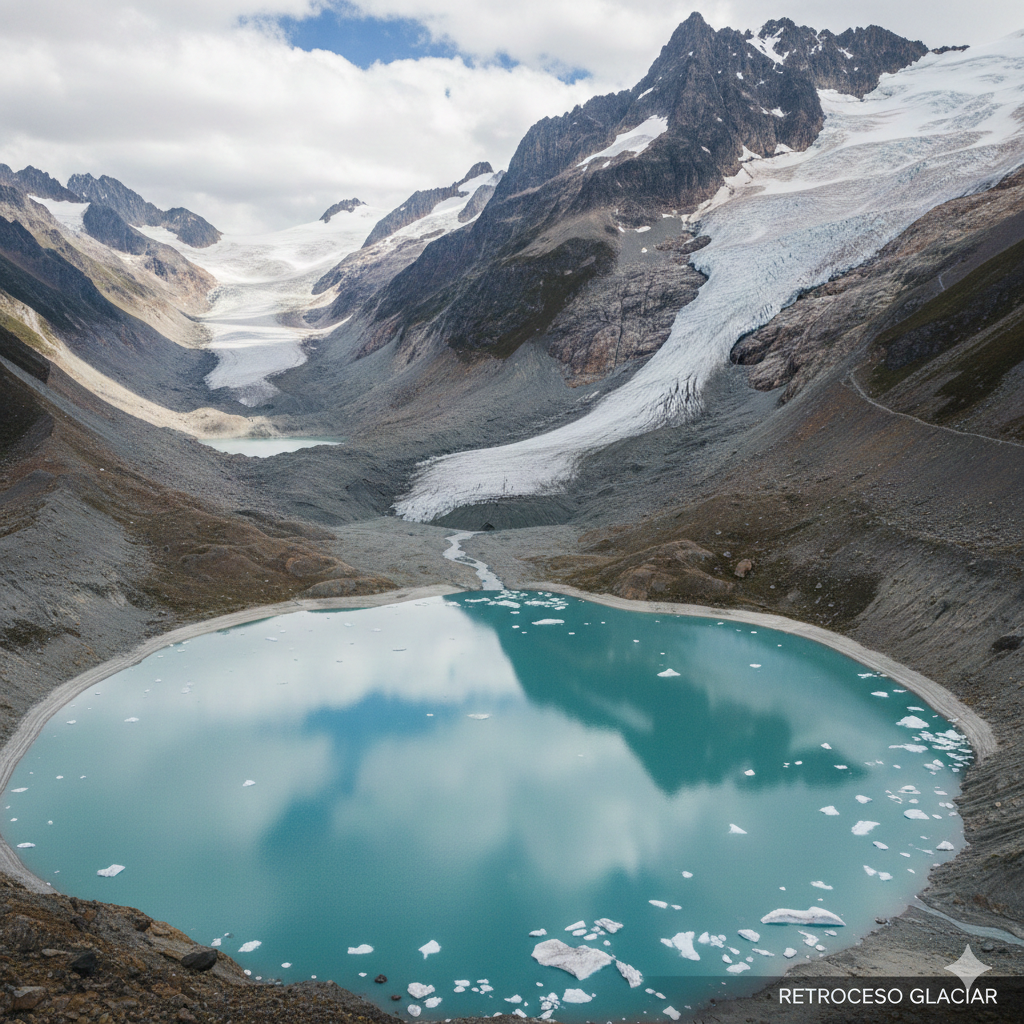
The glacier retreat of Nevado Pastoruri constitutes one of the most critical pieces of evidence of climate change in the Cordillera Blanca, generating significant environmental and socioeconomic alterations. The study was to spatially evaluate the glacier retreat of Nevado Pastoruri and its impact on tourism dynamics between 1987 and 2025. Where the multitemporal analysis of Landsat 5 TM, Landsat 7 ETM+, Landsat 8 OLI, and Landsat 9 OLI/TIRS satellite images was integrated, processed through the NDSI index (Normalized Difference Snow Index) and GIS tools, which allowed the delimitation and quantification of the variation of glacier surface area. Likewise, a linear projection model was applied to estimate the trend toward 2035, and tourism records reported by MINCETUR, SERNANP, and INAIGEM were analyzed. The results demonstrated a loss of 48% of the glacier area, decreasing from 21.09 km² in 1987 to 10.97 km² in 2025, with an average annual rate of 0.27 km². The projection to the year 2035, which estimates a surface reduced to 8.27 km², confirms the continuity of the glacier degradation process of Pastoruri, whose retreat not only evidences high environmental vulnerability, but also generates direct impacts on local tourism, reflected in the decrease in visitors, the transformation of the natural landscape, and the deterioration of the main economic activity of the area. Taken together, these results allow concluding that the glacier loss of Pastoruri constitutes a critical process with negative repercussions both on mountain ecosystems and on tourism activities that depend on this glacier attraction.
Downloads
References
Autoridad Nacional del Agua. Dirección de Conservación y Planeamiento de Recursos Hídricos. Unidad de Glaciología y Recursos Hídricos. (2014). Inventario de glaciares y lagunas del Perú. https://www.ana.gob.pe/sites/default/files/publication/files/inventario_de_glaciares_y_lagunas.pdf
Baraer, M., Mark, B. G., McKenzie, J. M., Condom, T., Bury, J., Huh, K. I., & Rathay, S. (2012). Glacier recession and water resources in Peru’s Cordillera Blanca. Journal of Glaciology, 58(207), 134–150. https://www.cambridge.org/core/journals/journal-of-glaciology/article/glacier-recession-and-water-resources-in-perus-cordillera-blanca/5CEA7495D2BF050058A6B7280FE89A12
Bousbaa, M., Boudhar, A., Kinnard, C., Elyoussfi, H., Karaoui, I., Eljabiri, Y., Bouamri, H., & Chehbouni, A. (2024). An accurate snow cover product for the Moroccan Atlas Mountains: Optimization of the MODIS NDSI index threshold and development of snow fraction estimation models. International Journal of Applied Earth Observation and Geoinformation,129,103851. https://www.sciencedirect.com/science/article/pii/S156984322400205X
Bury, J. T., Mark, B. G., Carey, M., Young, K. R., McKenzie, J. M., Baraer, M., French, A., & Polk, M. H. (2011). Glacier recession and human vulnerability in the Yanamarey watershed of the Cordillera Blanca, Peru. Climatic Change, 105(1–2), 179–206. https://doi.org/10.1007/s10584-010-9870-1
Escate, A., & Zamora, F. (2021). El descenso del Pastoruri y su relación con el turismo: ¿Podemos obtener algo bueno de ello? Ministerio del Ambiente del Perú.
Farinotti, D., Huss, M., Fürst, J., Landmann, J., Machguth, H., Maussion, F., & Pandit, A. (2019). A consensus estimate for the ice thickness distribution of all glaciers on Earth. Nature Geoscience, 12, 168–173. https://doi.org/10.1038/s41561-019-0300-3
Fyke, J., Sergienko, O., Löfverström, M., Price, S., & Lenaerts, J. T. (2018). An overview of interactions and feedbacks between ice sheets and the Earth system. Reviews of Geophysics, 56(2), 361–408. https://agupubs.onlinelibrary.wiley.com/doi/full/10.1029/2018RG000600
Gerber, E., Fournier, J., Salim, E., Fragnière, E., & Kebir, L. (2025). Systems thinking to adapt tourism to climate change: Application to summer glacier skiing in Switzerland. Annals of Tourism Research Empirical Insights. https://www.sciencedirect.com/science/article/pii/S2666957925000072
Gordon, J. E. (2023). Climate change and geotourism: Impacts, challenges, and opportunities. Geosciences, 4(4), 32. https://www.mdpi.com/2673-5768/4/4/32
Hock, R., Bliss, A., Marzeion, B., Huss, M., & Zemp, M. (2019). GlacierMIP – A model intercomparison of global-scale glacier mass-balance models and projections. Journal of Glaciology, 65(251), 453–467. https://doi.org/10.1017/jog.2019.22
Hugonnet, R., McNabb, R., Berthier, E., Menounos, B., Nuth, C., Girod, L., ... & Kääb, A. (2021). Accelerated global glacier mass loss in the early twenty-first century. Nature, 592(7856), 726–731. https://doi.org/10.1038/s41586-021-03436-z
Huss, M., & Hock, R. (2018). Global-scale hydrological response to future glacier mass loss. Nature Climate Change, 8(2), 135–140. https://doi.org/10.1038/s41558-017-0049-x
Instituto Nacional de Investigación en Glaciares y Ecosistemas de Montaña. (2020). Informe de la situación de los glaciares y ecosistemas de montaña en el Perú 2020. INAIGEM. https://hdl.handle.net/20.500.12748/647
Instituto Nacional de Investigación en Glaciares y Ecosistemas de Montaña (INAIGEM). (2023). Inventario Nacional de Glaciares y Lagunas de Origen Glaciar 2023 (INGLOG 2023). SINIA–Ministerio del Ambiente. https://sinia.minam.gob.pe/documentos/inventario-nacional-glaciares-lagunas-origen-glaciar-2023
Jennings, S. J., & Hambrey, M. J. (2021). Structures and deformation in glaciers and ice sheets. Reviews of Geophysics, 59(3), e2021RG000743. https://agupubs.onlinelibrary.wiley.com/doi/10.1029/2021RG000743
Leal, R., Velázquez, R., & Triana, J. (2023). Actividad turística, su contribución al desarrollo local. Análisis de productividad científica en bases de datos. Universidad y Sociedad, 15(6), 169–178. http://scielo.sld.cu/scielo.php?script=sci_arttext&pid=S2218-36202023000600169
Masiokas, M. H., Rivera, A., Espizua, L. E., Solomina, O., & Villalba, R. (2020). A review of the current state and recent changes of the Andean cryosphere. Frontiers in Earth Science, 8, 99. https://www.frontiersin.org/journals/earth-science/articles/10.3389/feart.2020.00099/full
Maurer, J. M., Schaefer, J. M., Rupper, S., & Corley, A. (2020). Acceleration of ice loss across the Himalayas over the past 40 years. Science Advances, 5(6), eaav7266. https://doi.org/10.1126/sciadv.aav7266
Ministerio de Comercio Exterior y Turismo. (s. f.). Estadísticas de turismo. https://www.gob.pe/mincetur
Organización del Tratado de Cooperación Amazónica (OTCA), & Autoridad Nacional del Agua (ANA). (2023). Monitoreo de glaciares tropicales busca mayor seguridad hídrica en el Perú. https://otca.org/monitoreo-de-glaciares-tropicales-busca-mayor-seguridad-hidrica-en-el-peru/
Pellicciotti, F., Ragettli, S., Carenzo, M., & McPhee, J. (2014). Changes in glacier mass balance and runoff from the Northern Patagonia Icefield from 1975 to 2011. The Cryosphere, 8(4), 1519–1541. https://doi.org/10.5194/tc-8-1519-2014
Pérez Forero, N. A. (2019). Ecoturismo de alta montaña: entre la conservación y el turismo. PNN Los Nevados, Sendero Conejeras. Turismo y Sociedad, (26),155–171. https://revistas.uexternado.edu.co/index.php/tursoc/article/view/6270
Portocarrero R., C. A. (2011). El cambio climático, la glaciología y los riesgos en la Cordillera Blanca Ancash – Perú. Aporte Santiaguino, 4(2), 208–215. http://revistas.unasam.edu.pe/index.php/Aporte_Santiaguino/article/view/547
Pozada-Rengifo, R., Bravo-Toledo, L., & Iparraguirre, J. (2023). Retroceso glaciar y el valor de los servicios ecosistémicos asociados con el recurso hídrico en la cuenca Parón–Parque Nacional Huascarán (Cordillera Blanca), 2009–2018. Tecnología y ciencias del agua, 14(4), 1–27.
https://revistatyca.org.mx/index.php/tyca/article/view/2985
Purdie, H. (2013). Glacier retreat and tourism: Insights from New Zealand. Mountain Research and Development, 33(4), 463–472. https://doi.org/10.1659/MRD-JOURNAL-D-12-00073.1
Rabatel, A., Francou, B., Soruco, A., Gomez, J., Cáceres, B., Ceballos, J. L., ... & Jordan, E. (2013). Current state of glaciers in the tropical Andes: A multi-century perspective on glacier evolution and climate change. The Cryosphere, 7(1), 81–102. https://doi.org/10.5194/tc-7-81-2013
Radić, V., Bliss, A., Beedlow, A. C., Hock, R., Miles, E., & Cogley, J. G. (2014). Regional and global projections of twenty-first century glacier mass changes in response to climate scenarios. Climate Dynamics, 42(1–2), 37–58. https://link.springer.com/article/10.1007/s00382-013-1719-7
Ragettli, S., Immerzeel, W. W., & Pellicciotti, F. (2016). Contrasting climate change impact on river flows from high-altitude catchments in the Himalayan and Andes Mountains. Proceedings of the National Academy of Sciences of the United States of America, 113(33), 9222–9227. https://doi.org/10.1073/pnas.1606526113
Shugar, D. H., Burr, A., Haritashya, U., Kargel, J. S., Watson, C. S., & Kennedy, M. (2021). Rapid worldwide growth of glacial lakes since 1990. Nature Climate Change, 11(12), 972–979. https://www.nature.com/articles/s41558-020-0855-4
Soto, V. (2024). La imposibilidad de pronosticar la extinción de un glaciar de montaña. Investigaciones Geográficas, (114), e60921. https://www.scielo.org.mx/scielo.php?script=sci_arttext&pid=S0188-46112024000200201
Thomas, K., Hardy, R. D., Lazrus, H., Rockman, M., Warner, B. P., Rivera-Collazo, I., Roberts, J. T., & Orlove, B. (2019). Explaining differential vulnerability to climate change: A social science review. WIREs Climate Change, 10(2), e565. https://wires.onlinelibrary.wiley.com/doi/10.1002/wcc.565?utm_source=researchgate.net&utm_medium=article
United States Geological Survey. (s. f.). EarthExplorer. https://earthexplorer.usgs.gov/
Veettil, B. K., & Kamp, U. (2019). Global warming and tropical Andean glaciers: Observations, trends, and future scenarios. Progress in Physical Geography, 43(4), 540–567. https://www.mdpi.com/2076-3263/9/5/196
Zemp, M., Huss, M., Thibert, E., Eckert, N., McNabb, R., Huber, J., Barandun, M., Machguth, H., Nussbaumer, S. U., & Paul, F. (2015). Historically unprecedented global glacier decline in the early 21st century. Journal of Glaciology, 61(228), 745–762. https://doi.org/10.3189/2015JoG15J017
Downloads
Published
Issue
Section
License
Copyright (c) 2025 Niler Rosario Chahua Garcia, Hatzia Angeline Landa Santiago, Frank James Tadeo Simón, Emmanuel Antonio Gómez Castro (Autor/a)

This work is licensed under a Creative Commons Attribution 4.0 International License.