Evaluation of the thermal behavior of a prefabricated triangular-structure ecotourism module
DOI:
https://doi.org/10.37711/repiama.2026.3.1.6Keywords:
ecotourism module, sustainable architecture, prefabrication, thermal insulation, solar control, solar energy, bioclimaticsAbstract
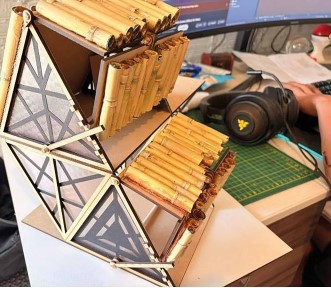
Ecotourism housing solutions face limitations in thermal comfort and energy efficiency due to the use of industrial materials and the lack of passive systems, which generates daytime overheating and nighttime heat loss. In view of this issue, the objective of the research was to evaluate the thermal efficiency of a prefabricated triangular-structure ecotourism module, that integrates a foldable system and reed-based biopanels bonded with prickly pear cactus mucilage. A descriptive methodology design was applied to evaluate a full-scale material test specimen exposed to outdoor conditions in Huánuco during two seasonal periods (dry and wet). Through direct quantitative observation, indoor and outdoor temperatures were recorded during periods of maximum solar radiation (10:00 a.m.) and cooling (4:00 p.m.). The results evidenced high thermal stability; in dry season, the indoor temperature variation was 9.2 °C, faced to 12.5 °C outdoors, and in wet season was only 3.5 °C, despite an outdoor fluctuation of 10.3 °C, maintaining a temperature between 7 and 15 °C higher than the outside temperature during critical hours. It is concluded that this comprehensive bioclimatic design constitutes a highly efficient passive climate control system that reduces dependence on artificial systems and ensures sustainability in natural environments.
Downloads
References
Cobana, M., y Antezana, R. (2007). Proceso de extracción de almidón de yuca por vía seca. Revista Boliviana de Química, 24(1), 77-83. http://www.scielo.org.bo/pdf/rbq/v24n1/v24n1a14.pdf
Gere, J. M., y Timoshenko, S. P. (1997). Mecánica de materiales (4.a ed.; J. de la Cera Alonso, trad.). International Thomson Editores.
Givoni, B. (1994). Enfriamiento pasivo y de baja energía en edificios. John Wiley & Sons.
Givoni, B. (1998). Climate considerations in building and urban design [Consideraciones climáticas en el diseño de edificios y urbanismo]. John Wiley & Sons.
González Meza, E. (2016). Estructuras de retícula triangular: transformaciones constructivas de las edificaciones [Tesis doctoral, Universidad Politécnica de Madrid]. Repositorio Institucional UPM. https://doi.org/10.20868/UPM.thesis.42929
Hiromoto, C. (2016, 6 de noviembre). Pempén: módulo transformable para la selva por estudiantes peruanos. ArchDaily. https://www.archdaily.cl/cl/797538/pempen-modulo-transformable-para-la-selva-por-estudiantes-peruanos/581de7dfe58ece9230000075-pempen-modulo-transformable-para-la-selva-por-estudiantes-peruanos-proceso-de-construccion?next_project=no
Honey, M. (2008). Ecotourism and sustainable development. Who owns paradise? [Ecoturismo y desarrollo sostenible. ¿Quién es el dueño del paraíso?] (2.a ed.). Island Press.
Feugang, J. M., Konarski, P., Zou, D., Stintzing, F. C., & Zou, C. (2006). Nutritional and medicinal use of Cactus pear (Opuntia spp.) cladodes and fruits. Frontiers in Bioscience, 11(3), 2574-2589. https://doi.org/10.2741/1992
Kronenburg, R. (2007). Flexible: Architecture that responds to change [Flexible: arquitectura que responde al cambio]. Laurence King Publishing.
Lewandowski, I., Scurlock, J. M. O., Lindvall, E., & Christou, M. (2003). The development and current status of perennial rhizomatous grasses as energy crops in the US and Europe. Biomass and Bioenergy, 25(4), 335-361. https://doi.org/10.1016/S0961-9534(03)00030-8
Neila González, F. J. (2004). Arquitectura bioclimática en un entorno sostenible. Munilla-Lería.
Olgyay, V. (2015). Design with climate: Bioclimatic approach to architectural regionalism [Diseño con el clima: enfoque bioclimático del regionalismo arquitectónico]. Princeton University Press.
Pérez, G., Rincón, L., Vila, A., González, J. M., & Cabeza, L. F. (2011). Green vertical systems for buildings as passive systems for energy savings. Applied Energy, 88(12), 4854-4859. https://doi.org/10.1016/j.apenergy.2011.06.032
Smith, R. E. (2010). Prefab architecture: A guide to modular design and construction [Arquitectura prefabricada: una guía para el diseño y la construcción modular]. John Wiley & Sons.
Torroja, E. (1957). Razón y ser de los tipos estructurales. Instituto Técnico de la Construcción y del Cemento.
World Intellectual Property Organization. (2024). 1. PE2024-1165 - Módulo de estructura triangular prefabricado, armable y rebatible con aislamiento térmico y control de asoleamiento. PATENTSCOPE. https://patentscope.wipo.int/search/en/detail.jsf?docId=PE433335122
Downloads
Published
Issue
Section
License
Copyright (c) 2026 Efrain Culqui Gutierrez, Johnnatan Scott Hernández Zevallos, Efraín Culqui Gutiérrez, José Arturo Pérez Santa María, Lizbeth Daniela Aguirre Ordóñez, Héctor Raúl Zacarías Ventura (Autor/a)

This work is licensed under a Creative Commons Attribution 4.0 International License.